
Core Channels and Budget Allocation for Law Firm Marketing

Successful law firm marketing requires four foundational components: high-intent organic SEO, local search and Google Business Profile optimization, rapid intake systems that respond within five minutes, and a secure, mobile-responsive conversion website. Prioritizing these channels ensures your practice captures qualified search demand, establishes local credibility, and systematically turns inquiries into retained clients.
Navigating the modern legal marketplace requires a deliberate channel mix. With 96% of individuals seeking legal advice beginning their journey on search engines, relying solely on offline referrals or word-of-mouth is no longer a viable long-term strategy. The broader legal services sector spent an estimated $2.5 billion on advertising recently, showing that visibility has become a critical battleground.
According to Law firm marketing statistics for 2026: A comprehensive analysis, firms generally commit between 2% and 10% of their gross revenue toward marketing and client acquisition, though solo practitioners often operate closer to 1% to 2%. What separates thriving firms from stagnant ones is not just the volume of capital spent, but where that capital is deployed. High-growth firms, those growing at rates over 40% annually, routinely focus their resources on search engine visibility, structured intake systems, and trust-building digital assets.
Scaling Organic Reach and Paid Client Acquisition
When evaluating customer acquisition channels, search engine optimization (SEO) and paid search advertising (Pay-Per-Click or PPC) represent the two primary engines of digital growth. However, their underlying economics differ substantially.
SEO remains the highest-performing channel over a multi-year horizon, because rankings keep working after the spend stops. Organic search traffic also tends to convert visitors into qualified inquiries at a meaningfully higher rate than paid search, where the click is bought rather than earned.
Paid advertising still plays a role, especially for immediate lead volume in competitive fields. However, costs continue to climb. Acquiring a single signed case through paid search channels regularly costs between $2,500 and $3,000 in competitive practice areas like personal injury or mass torts. To balance these costs, many practices use Google Local Service Ads for Lawyers, which operate on a pay-per-lead model with prominent Google Screened placement above standard search ads.
| Channel / Metric | Average Conversion Rate | Cost Dynamics | Long-Term Compounding Asset | Primary Use Case |
|---|---|---|---|---|
| Organic SEO | 7.5% | Fixed monthly investment; decreasing cost-per-lead over time | Yes (authority builds value) | Sustainable, high-intent client generation |
| Paid Search (PPC) | 2.2% | $2,500 to $3,000 per signed case; ongoing spend required | No (traffic stops when spend stops) | Immediate visibility and short-term caseload spikes |
| Local Service Ads (LSA) | 5.0% to 10.0% | Pay-per-valid-lead; tiered by market and practice | Partial (review count builds placement) | High-trust local direct calls |
Budget Allocation Frameworks for Modern Practices
A surprising industry reality is that only 47% of law firms maintain a formalized annual marketing budget. Without a clear plan, spending tends to be reactive, leading to wasted spend on low-yield directories or unfocused print campaigns.
For smaller practices, Solo Lawyer Marketing requires a lean framework. We recommend the AEIOU business planning model:
- Audit: Review current intake numbers, cost per lead, and revenue by practice area.
- Embed Experience: Build your digital presence around documented case wins, credentials, and practice-specific experience.
- Act Intentionally: Commit at least 45% of your digital budget to organic search and reputation before experimenting with speculative ad channels.
- Originate: Produce unique, lawyer-authored written content that addresses specific client search questions.
- Utilize: Implement software to measure lead sources, conversion rates, and client intake speeds.
As highlighted in the Legal Marketing Decision-Makers Survey, top marketing leaders prioritize written content creation, profile building, and webinars over passive legal awards and paid directory profiles. Strategic allocation ensures every dollar spent contributes directly to qualified consultations.
High-Impact Digital Infrastructure and Conversion Strategies
Securing clicks is only half the battle. If prospective clients arrive at an outdated, slow, or confusing website, your marketing budget is wasted. Developing the Best Law Firm Internet Marketing ecosystem starts with conversion architecture: structuring your site so visitors can easily confirm your credibility, understand your solutions, and immediately reach your intake team.

Essential Checklists for Law Firm Marketing Websites
Your firm's website is your central digital storefront. To maximize conversion rates, ensure the following technical and structural standards are in place:
- Mobile-First Design: Most people searching for a lawyer are doing it on a phone, and they expect pages to load fast on a cellular connection.
- Technical Security (SSL): Even now, fewer than half of all law firm websites maintain an active, properly configured SSL certificate. Without HTTPS, modern browsers display prominent security warnings that deter visitors.
- Granular Practice Area Pages: Avoid broad overview pages. Build dedicated, localized pages for specific matters (for example, commercial lease disputes, uncontested divorce, truck accidents) to capture high-intent search queries.
- Prominent Trust Signals: Highlight local bar memberships, verified client reviews, published case results (with compliant disclaimers), and clear attorney biographies.
- Direct Conversion Points: Provide multiple ways to reach your office on every page, including click-to-call phone numbers, simple contact forms, and direct consultation scheduling links.
Firms that invest in modern, high-performing Winning Websites establish the foundation needed to convert web traffic into retained clients.
Rapid Client Intake and AI Integration
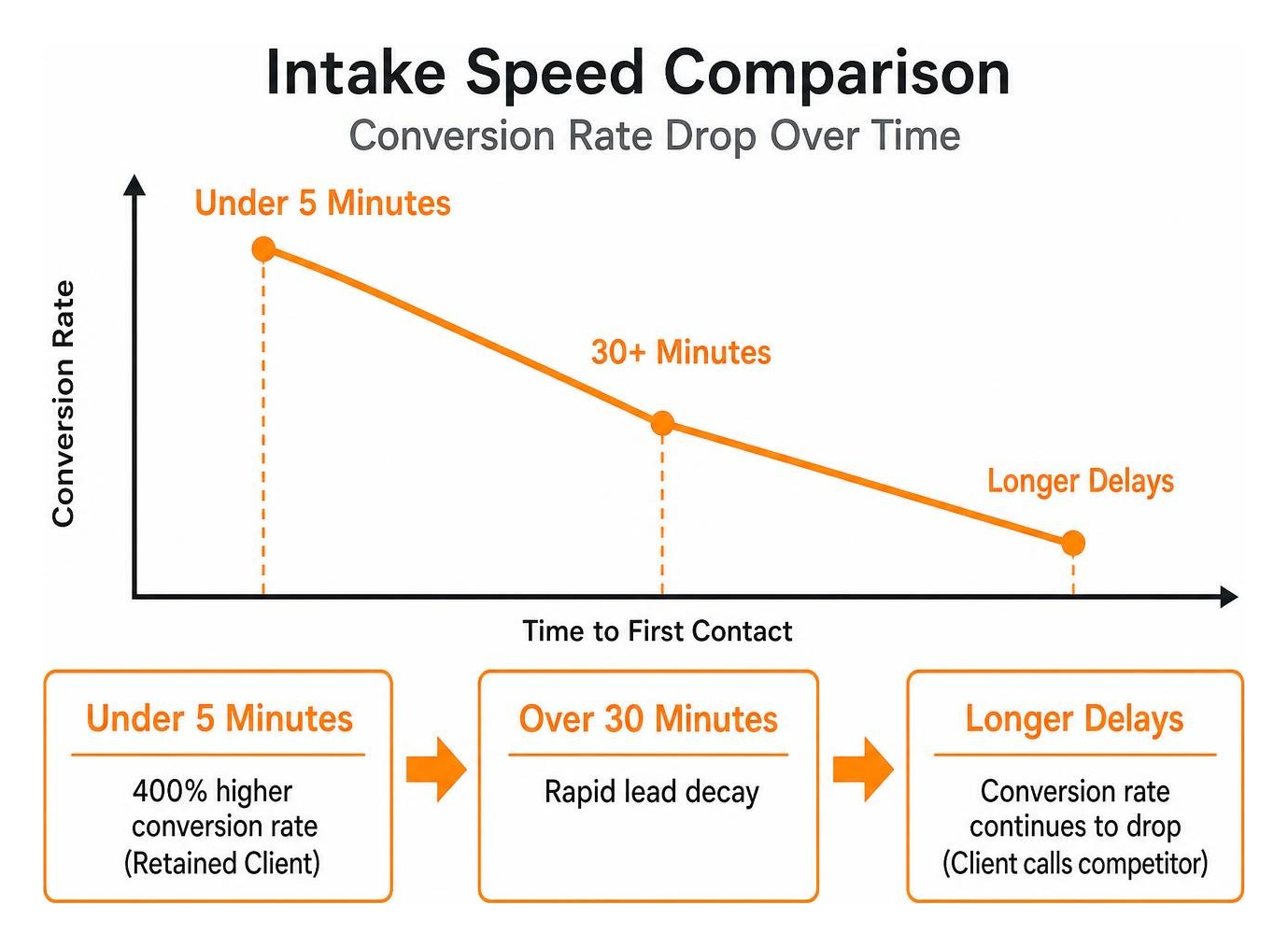
Intake is where marketing investments succeed or fail. Nationwide, the average phone-call-to-retained-case conversion rate sits around 7%, but top-performing firms achieve rates exceeding 25% to 30%. The deciding factor is often response speed.
Law practices that contact a prospective client within five minutes of an inquiry experience a 400% higher conversion rate compared to firms that take thirty minutes or longer. Legal inquiries are time-sensitive; individuals facing legal emergencies will quickly move down the search results until someone answers their call.
This need for speed explains why AI adoption across the legal sector surged from 19% to 79% in recent years. Marketing-focused law firms use AI tools and automated chat systems to handle after-hours inquiries, gather preliminary matter details, and instantly book consultations. Understanding Why Every Law Firm Website Needs Chat Software Today can help small practices implement automated, around-the-clock intake pathways to capture leads when staff are unavailable. These automation systems are instrumental in achieving 4x Conversions from existing site traffic.
Reputation Management and Local Visibility Tactics
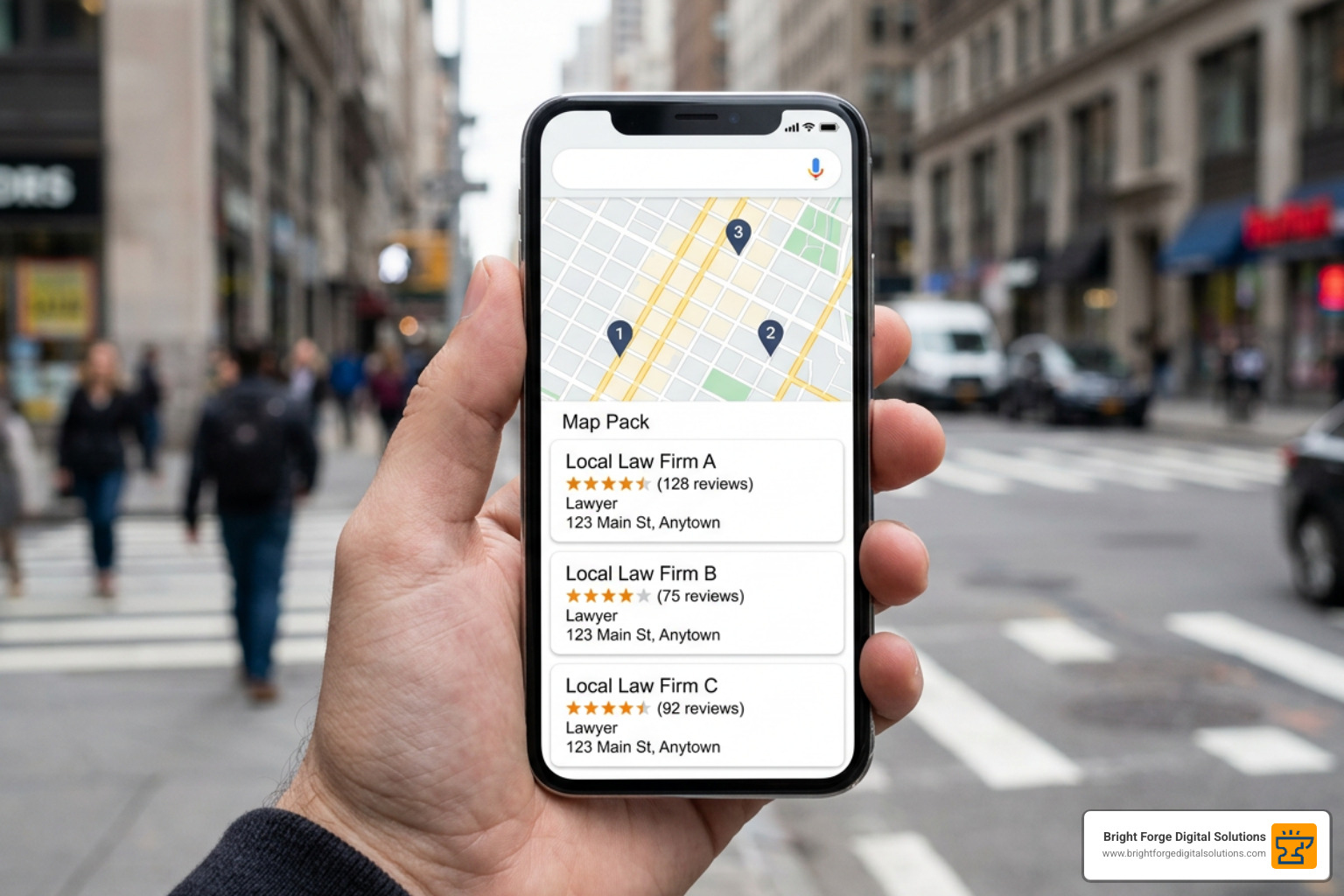
Local visibility forms the cornerstone of new client acquisition for consumer and small business law firms. Prospective clients prefer working with local practitioners, making top placement in the Google Map Pack and local search results essential for consistent lead generation.
Dominating Local Search and Directory Ecosystems
To rank in Google's local 3-pack, firms must maintain an active, optimized presence across several interconnected touchpoints:
- Google Business Profile (GBP) Optimization: Select accurate primary and secondary categories (for example, "Personal Injury Attorney" or "Estate Planning Attorney"), publish regular updates, and maintain identical Name, Address, and Phone (NAP) data across the web.
- Review Generation Systems: BrightLocal's Local Consumer Review Survey found that roughly 97% of consumers read reviews before choosing a local business, so firms must implement automated post-case review workflows. A steady flow of five-star Google reviews directly influences local search rankings and client confidence.
- Local Citation Consistency: Maintain synchronized listings across major platforms like Apple Maps, Bing Places, and recognized legal directories.
Implementing comprehensive Local SEO for Law Firms ensures your practice appears when prospective clients search for nearby counsel. Pairing local optimization with a structured Review Generation and Reputation system creates an authentic trust signal that advertising alone cannot replicate.
Advanced Law Firm Marketing Metrics and ROI Tracking
Law firm marketing should operate as a measurable business function rather than an unpredictable expense. To evaluate performance accurately, firm leadership must track core key performance indicators (KPIs) beyond superficial traffic numbers:
- Cost Per Acquisition (CPA): The total marketing spend required to sign one paying client, tracked by individual channel.
- Lead-to-Consultation Rate: The percentage of incoming calls, chats, and forms that convert into scheduled consultations.
- Consultation-to-Retainer Rate: The percentage of completed consultations that result in a signed engagement agreement.
- Intake Speed-to-Lead: The average time elapsed between an incoming inquiry and your team's first direct contact attempt.
For firms tired of speculative monthly retainer fees with uncertain outcomes, performance-aligned models such as Pay Per Result SEO offer an alternative. Under this model, firms only pay for SEO services when targeted, high-intent keywords achieve first-page Google rankings.
Frequently Asked Questions About Legal Growth
What is the most effective marketing channel for law firms in 2026?
Organic search engine optimization combined with Google Business Profile optimization delivers the highest sustained return over a multi-year horizon. Because rankings continue producing inquiries after the spend stops, and because searchers arriving organically have already decided they need a lawyer, SEO generally outperforms paid search and social media advertising on cost per signed case.
How should small law firms allocate their marketing budget?
Small practices and solo attorneys should allocate 5% to 10% of gross revenue toward marketing. Priority should be given to foundational digital assets: a fast, mobile-friendly website, local SEO, Google Business Profile management, and review generation tools. High-cost PPC campaigns should only be added once an efficient intake system is in place to capture and convert incoming leads.
Why is rapid lead response critical for intake conversion?
Contacting a prospective client within five minutes of an initial inquiry yields a 400% higher conversion rate compared to longer response windows. Legal consumers frequently contact multiple firms; the first firm to provide a professional, empathetic response is far more likely to retain the client.
Conclusion
Building a sustainable, growing law practice requires a strategic approach: developing high-performance digital assets, dominating local search rankings, building a strong online reputation, and maintaining rapid intake systems. When these elements operate together, marketing transforms from an unpredictable expense into a reliable driver of firm growth.
At Bright Forge Digital Solutions, we specialize in helping solo attorneys and small law firms scale their practices through transparent, performance-driven marketing. We back our search engine strategies with a unique pay-per-result model, so you only pay when your target keywords reach Google's first page. Discover how our specialized legal marketing services can increase your consultations and build lasting local visibility.
Want help putting this into practice at your firm?
Get a free Growth Plan built for your practice area and market. About two minutes, no call required.
Get my free Growth Plan