

The legal marketing trends that matter in 2026 are the ones that change who gets the call: AI-generated search answers, local visibility, third-party reputation, faster intake, and advertising ethics rules that now reach your AI tools. Most other “trends” are tactics. This guide separates the shifts that move booked consultations from the ones that only move vanity metrics, and it tells you what to do about each.
We work only with law firms, so our bias is plain: we care about consultations, not clicks. The data cited below comes from the sources listed at the end.
TL;DR
- AI summaries are reducing clicks to ordinary search results, so visibility now includes being named in AI answers, not only ranking on page one.
- Local search still decides most consultations, and Google says local ranking rests on relevance, distance and prominence, none of which you can buy.
- Reviews and third-party profiles are the trust layer for both human readers and AI systems.
- Speed of intake (chat, answering, follow-up) is where many firms lose cases they already paid to attract.
- Every tactic sits under advertising and confidentiality rules. Check Rules 7.1, 5.3 and 1.6 before you automate anything.
Table of Contents
- Trend 1: Search is turning into “ask and chat”
- Trend 2: Generative engine optimization builds on SEO, not instead of it
- Trend 3: Local search still decides who gets the consultation
- Trend 4: Reviews are the trust layer
- Trend 5: Intake speed and technology confidence
- Trend 6: Ethics rules now govern your marketing stack
- Trend 7: Performance-based pricing and accountability
- Our perspective: fewer tactics, a connected system
- A 90-day plan you can start this quarter
- Work with a team that only serves law firms
- FAQ
- Sources
Trend 1: Search is turning into “ask and chat”
The biggest structural change is that a growing share of searches ends on Google’s own summary or in an AI assistant. A compilation of Pew Research data reports that, as of March 2025, US users clicked a traditional result in 8% of visits when an AI summary appeared, versus 15% without one, and only 1% clicked links inside the summaries. The Pew study itself was covered by Search Engine Journal, which framed it as evidence that AI Overviews send little traffic back to websites.
For a law firm, this does not mean search is dead. It means a click is harder to earn and a mention is more valuable. A related pattern described in the American Bar Association’s Law Practice magazine is “discover on ChatGPT, hire on Google”: people ask an AI tool for options, then search your firm’s name before they call. Branded searches rise, but clicks on generic results do not.
What to do about it
- Own your brand search. Search your firm name and attorney names. The first page should show an accurate Google Business Profile, your site, and strong third-party profiles.
- Answer questions plainly on your site. Practice pages that state who you help, where, and what happens next are easier for both people and AI systems to quote.
- Measure consultations, not sessions. If traffic falls but booked calls hold, the strategy is working.
We cover this shift in more detail in our piece on AI Overviews and law firm search.
Trend 2: Generative engine optimization builds on SEO, not instead of it
“GEO” is the label for earning mentions in AI answers. The useful part is not new. The ABA’s Law Practice Today has noted that AI services draw primarily on law firm websites, lawyer directory profiles and business listings, and projects that AI may eventually overtake search as the main way people look for a lawyer.
The March-April 2026 ABA article makes a useful point: succeeding in this environment does not mean abandoning SEO. It means reprioritizing where you build authority, with consistent, descriptive presence on the established directories that AI systems use to validate expertise.
In practice, that means three habits:
- Consistent name, address and phone data everywhere your firm appears. Inconsistent listings give AI systems conflicting facts.
- Complete, specific profiles on legal directories and on Google, with practice areas, jurisdictions and bar admissions stated the same way each time.
- Fundamentals of SEO: crawlable pages, clear practice-area structure, and genuine local relevance. Our SEO for law firms explainer walks through them.
Listing consistency is also the reason we offer business and voice search listings.
Trend 3: Local search still decides who gets the consultation
A person with a car accident, a custody dispute or an immigration problem usually wants a lawyer who is nearby and credible. Google’s own guidance says local results are based on relevance, distance and prominence, and that you cannot pay for a better local ranking. Relevance comes from complete business information, distance from where the searcher is, and prominence from things like reviews, links and how you perform in organic search.
That is why “hyper-local” content keeps showing up in trend lists. For a firm in Birmingham, Tampa or Little Rock, it translates to:
- A fully completed Google Business Profile for each office, with accurate categories, hours and services.
- Pages for each city or county you actually serve, written about real local matters rather than swapped place names.
- Local links and mentions: bar associations, chambers of commerce, community sponsorships.
If you want a practical walk-through, see our Google Business Profile guide for law firms and the 2026 local SEO playbook for law firms.
Paid local channels
Paid placement is a different lever from local organic ranking. Google Local Services Ads put your firm at the top of results in some markets, with a pay-per-lead model rather than pay-per-click. Eligibility, verification and pricing vary by practice area and location, so read our guide to Google Local Service Ads for lawyers and the note on how Local Services Ads for law firms are moving before you budget. Search ads are a separate option, covered by our Google Ads campaigns.
Trend 4: Reviews are the trust layer
When two firms look equally qualified, reviews break the tie. The ABA’s attorney advertising FAQ summarizes legal consumer research showing that nearly 70% of potential clients cite reviews as the most helpful element when choosing an attorney. Reviews also feed local prominence, and the ABA’s GEO article stresses finding ways to inspire people to publish something positive about you online.
The trend is moving from “ask when you remember” to a systematic, compliant request after each matter closes. Three rules keep that safe:
- Ask every satisfied client, not a hand-picked few, and never offer something of value in exchange for a positive review.
- Never confirm client status or case details in a reply. The ABA FAQ advises general, non-substantive responses to negative reviews that move the conversation offline, because Rule 1.6 on confidentiality still applies.
- Respond to every review, positive or negative, in a consistent professional voice.
Our review generation automation handles the request workflow, and our ethical guide to Google lawyer reviews covers the compliance side in more depth.
Trend 5: Intake speed and technology confidence
Marketing that generates a call nobody answers is wasted spend. Clients also judge you by how your firm handles technology. An Integris report found that 83% of clients say technology affects their confidence in a firm, and 35% have switched or considered switching mainly because of technology and operational failures. That is a survey with a vendor behind it, so treat it as directional, but it matches what we see: slow replies lose consultations.
The practical response is a short intake audit:
| Question | What good looks like |
|---|---|
| How fast is the first reply to a web inquiry? | Minutes, not the next business day |
| What happens after hours? | A chat or answering flow that captures details and offers a consultation slot |
| Who follows up on missed calls? | A named person and a written process |
| Is the site accessible and fast on mobile? | Yes, tested on real phones |
AI chat and answering tools can cover nights and weekends by qualifying a lead and booking an appointment. Our AI-based chatbots are built for that first after-hours conversation. For the reasoning, read why every law firm website needs chat software.
Trend 6: Ethics rules now govern your marketing stack
Every trend above runs into the professional conduct rules. The ABA’s FAQ on attorney advertising explains that Model Rules 7.1, 7.2 and 7.3 govern advertising, with Rule 7.1 prohibiting false or misleading statements, including those that create unjustified expectations about results. The same source notes that lawyers remain responsible for the AI tools they use (Rule 5.3), and that chatbots and AI-generated content must not inadvertently form an attorney-client relationship, give unauthorized legal advice or breach confidentiality under Rule 1.6.
That has concrete consequences:
- Chatbots need clear language that they are not giving legal advice, and a flow that avoids collecting privileged detail before conflicts are checked.
- AI-written content needs attorney review before publication.
- Testimonials and results claims need to meet your state’s version of the rules, which can differ from the ABA model.
Before launching any of this, check your own state bar’s advertising rules, or ask your firm’s ethics counsel. The ABA model rules are a template, and your state’s adopted version controls.
Trend 7: Performance-based pricing and accountability
The wider legal market is under pressure to show value. Thomson Reuters’ 2026 legal report found that 71% of in-house legal professionals expect their outside firms to change commercial models, while only 28% of firms have. That is about client billing, but the same mindset has reached marketing budgets: partners want to know what a dollar of marketing returned.
Two habits follow. First, track a short chain: impressions, calls, forms, qualified consultations, retained matters. Second, prefer contracts where the vendor shares the risk. That is the thinking behind our Pay Per Result SEO, where you pay when agreed first-page rankings are achieved. You can read how it works in our explainer on Pay Per Result SEO for law firms.
A ranking is not a retained client, so we pair it with the intake and review work above. Ask any agency, including us, how rankings connect to consultations.
Our perspective: fewer tactics, a connected system
Here is what we have learned from working only with law firms. We look at marketing through the client journey: a person searches, compares, checks reviews, contacts the firm and decides whether to book. A weak link at any step wastes the strong ones.
When firms ask us which trend to chase first, we do not start with the newest. We ask four questions:
- Does your Google Business Profile accurately describe each office and practice area?
- Do your reviews reflect the quality of your work, and do you collect them consistently?
- When someone reaches out at 9 p.m., what happens?
- Can you tell which channel produced last month’s consultations?
Most firms that answer “not sure” to two of these gain more from fixing them than from adding video, social or a new content series. Those channels can help, but they amplify a working system rather than create one. We also prefer to be measured on consultations and rankings tied to them, not on traffic reports.
One caution: automation is a convenience, never a delegation of professional responsibility. Whatever you install, the firm remains accountable for what it says.
A 90-day plan you can start this quarter
Days 1 to 30: fix the foundations. Audit your Google Business Profile, directory listings and website. Correct inconsistent names and phone numbers. Check the site on a phone. Our law firm marketing checklist lists the items to cover.
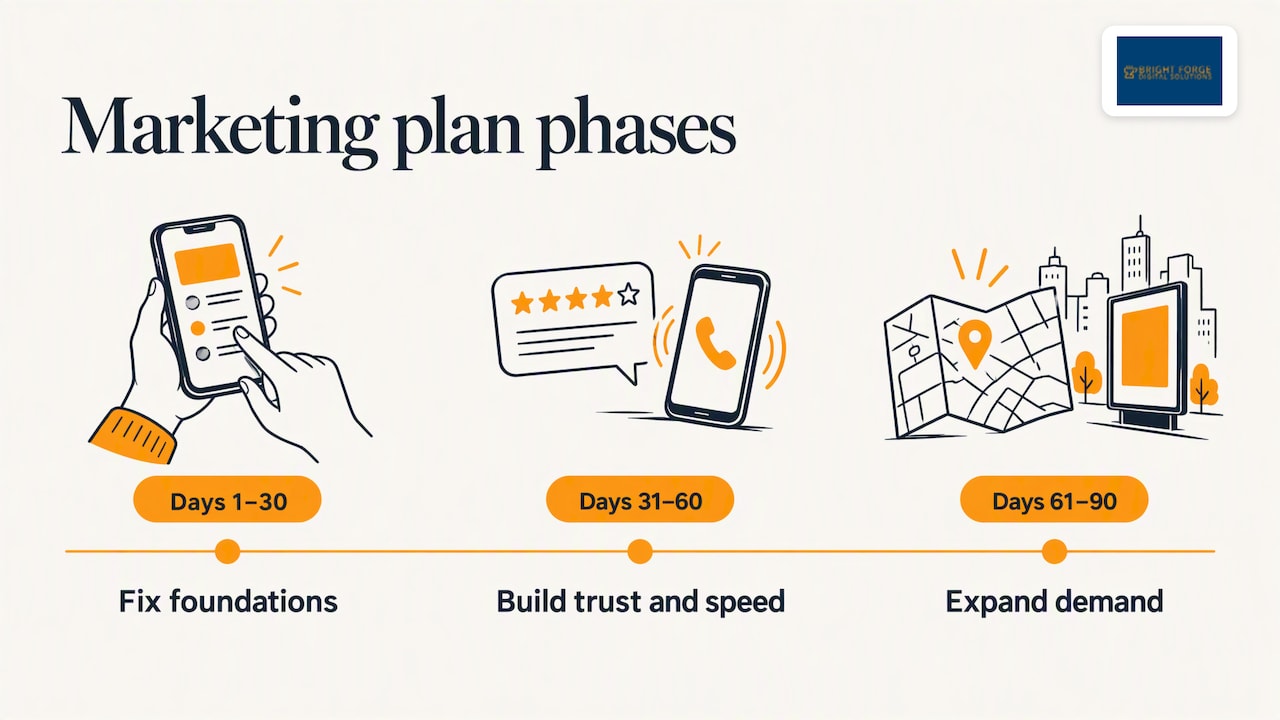
Days 31 to 60: build trust and speed. Start a consistent review request after each closed matter. Set up an after-hours intake path and a follow-up rule for missed calls. Draft a plain-language chatbot disclaimer for ethics review.
Days 61 to 90: expand demand. Add or sharpen city-specific practice pages. Test one paid channel, such as Local Services Ads or search ads, with a clear cost-per-consultation target. Review results and decide what to scale.
For a fuller strategic view, see our law firm internet marketing strategy.
Work with a team that only serves law firms
If you want help with local SEO, Google Business Profile optimization, reviews, Local Service Ads or AI intake, Bright Forge Digital Solutions works exclusively with law firms and builds campaigns around booked consultations. Tell us your practice areas and cities, and we will show you where the biggest gap is.
Frequently asked questions
What are the top legal marketing trends right now?
The most consequential are AI-generated search answers, local SEO and Google Business Profile quality, systematic review collection, faster client intake through chat and answering tools, and compliance with advertising rules. Video and social media matter, but they work best on top of those foundations.
Is SEO still worth it for law firms with AI Overviews?
Yes, but the goal widens. Clicks on traditional results drop when an AI summary appears, so firms need strong rankings and consistent presence on profiles and directories that AI systems draw on. Local intent searches still send people to firms they can call.
Can a law firm use an AI chatbot ethically?
Yes, with supervision. The ABA’s guidance points to Rule 5.3 (responsibility for tools), Rule 1.6 (confidentiality) and the risk of accidentally forming an attorney-client relationship. Use clear disclaimers, limit what the bot collects, and check your state bar’s rules.
Can I pay Google for a better local ranking?
No. Google states that local ranking depends on relevance, distance and prominence and cannot be bought. You can, however, run paid placements such as Local Services Ads or search ads, which appear separately from organic local results.
Sources
- Google Business Profile Help: Tips to improve your local ranking on Google
- AI Search & GEO Statistics 2026
- Search Engine Journal: Pew Research on Google AI Overviews
- ABA Law Practice magazine: AI-Powered Search Visibility for Law Firms
- ABA Law Practice Today: Law Firm Visibility in the Age of Generative AI
- ABA: FAQs on Attorney Advertising and Ethics Rules in the Digital Age
- Integris: Law firm trust and technology report
- Thomson Reuters Institute: Future of Professionals 2026 Legal Report
Recommended
- Law Firm Internet Marketing Strategy
- Local SEO for Law Firms: The 2026 Playbook
- Family Law Marketing: The 2026 Guide
- Ultimate Checklist for Law Firm Marketing
Want help putting this into practice at your firm?
Get a free Growth Plan built for your practice area and market. About two minutes — no call required.
Get my free Growth Plan