Why a Law Firm Chatbot Matters in 2026
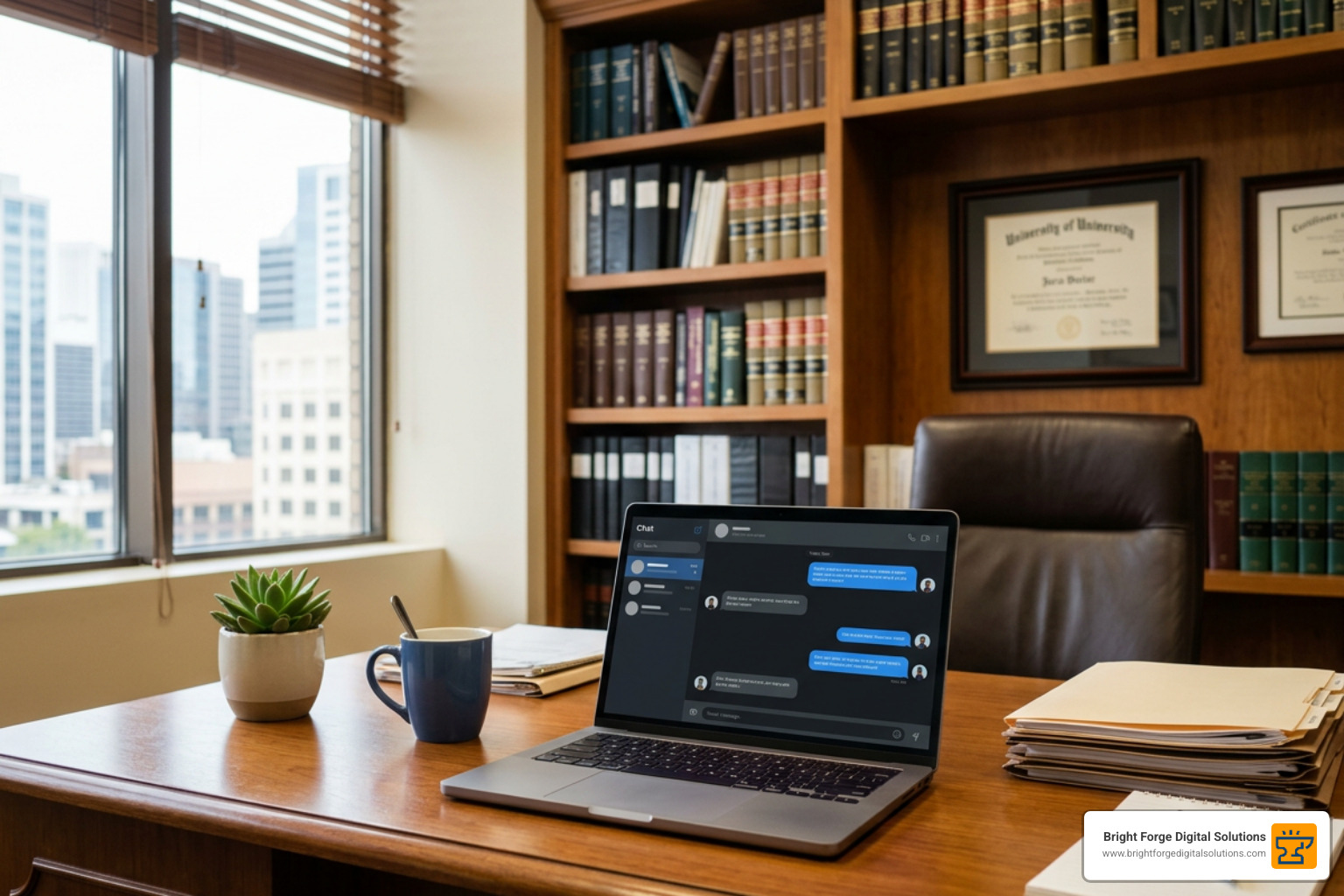
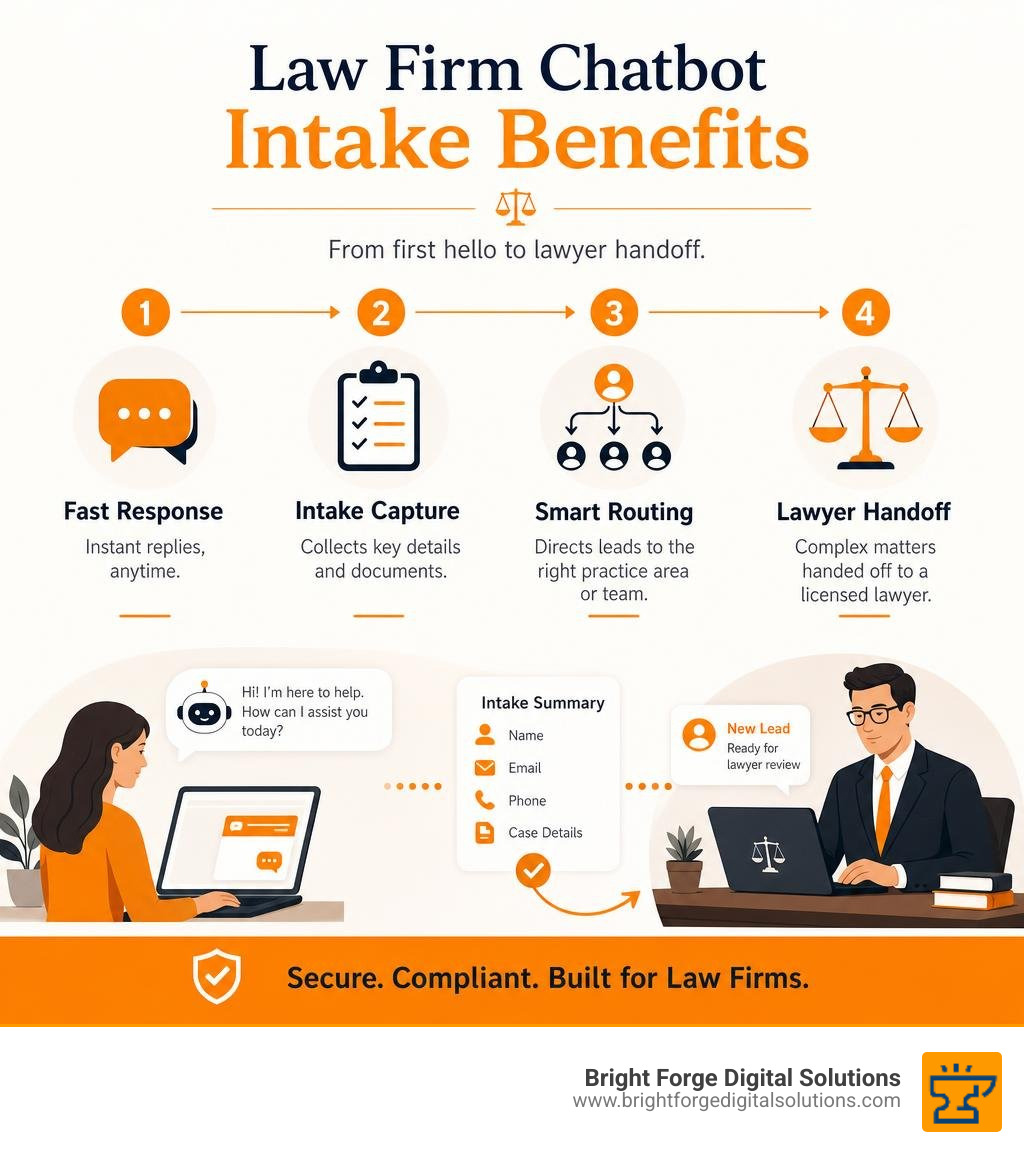
A law firm chatbot is website chat software that responds to visitors, answers approved basic questions, gathers intake details, and helps qualified prospects book a consultation - even when your office is closed.
| What it does | Why it matters |
|---|---|
| Responds right away | Prospects do not have to wait until the next business day for a first reply. |
| Collects intake details | Your team receives a clearer summary before the first call. |
| Answers routine questions | Visitors can get help with office hours, consultation steps, fees, and document checklists. |
| Routes the right leads | Matters can be sent to the proper practice area or staff member. |
| Hands off complex questions | Legal advice and sensitive case issues still go to a licensed lawyer. |
For a solo or small firm, this is less about replacing people and more about removing friction. A potential client may reach out late at night, feel uneasy about making a phone call, or simply choose the first firm that responds. Chat software gives your website a way to acknowledge that person quickly while your lawyers and staff focus on work that requires judgment.
The key is scope. A good legal chatbot handles administrative information and intake , not legal advice. It should be clear that the visitor is speaking with automated software, protect submitted information, and create a simple path to a real person.
I am Nick Saucier, longtime Judge Advocate General, and former staff attorney who also works with solo and small firms through Bright Forge Digital Solutions. In this guide, I will explain what a law firm chatbot can realistically do, where its limits belong, and how to evaluate your options.
What Is a Law Firm Chatbot and How Does It Work?
To understand why modern chat software is transforming legal marketing, we first need to distinguish specialized legal technology from consumer-grade tools. A law firm chatbot is an automated conversational assistant built explicitly for the workflows, compliance requirements, and client acquisition goals of a law practice.
Generic AI models like basic consumer chatbots are trained on broad internet text. While they can draft emails or summarize general articles, they lack legal guardrails, context, and secure system integrations. In contrast, legal chat systems leverage advanced large language models (LLMs) combined with natural language processing (NLP) and specialized legal datasets.
Historically, website chat relied on rigid, rule-based decision trees. If a user typed a phrasing the programmer did not anticipate, the conversation broke down. Today's conversational tools combine structured logic with retrieval-augmented generation (RAG). RAG allows the software to query approved firm knowledge bases—such as practice area descriptions, fee policies, document checklists, and intake questionnaires—and generate clear, highly contextual responses anchored exclusively in verified facts.
When paired with a strong strategy for Local SEO for Law Firms, a website chatbot ensures that local traffic converting from Google search listings gets engaged the second they hit your page.
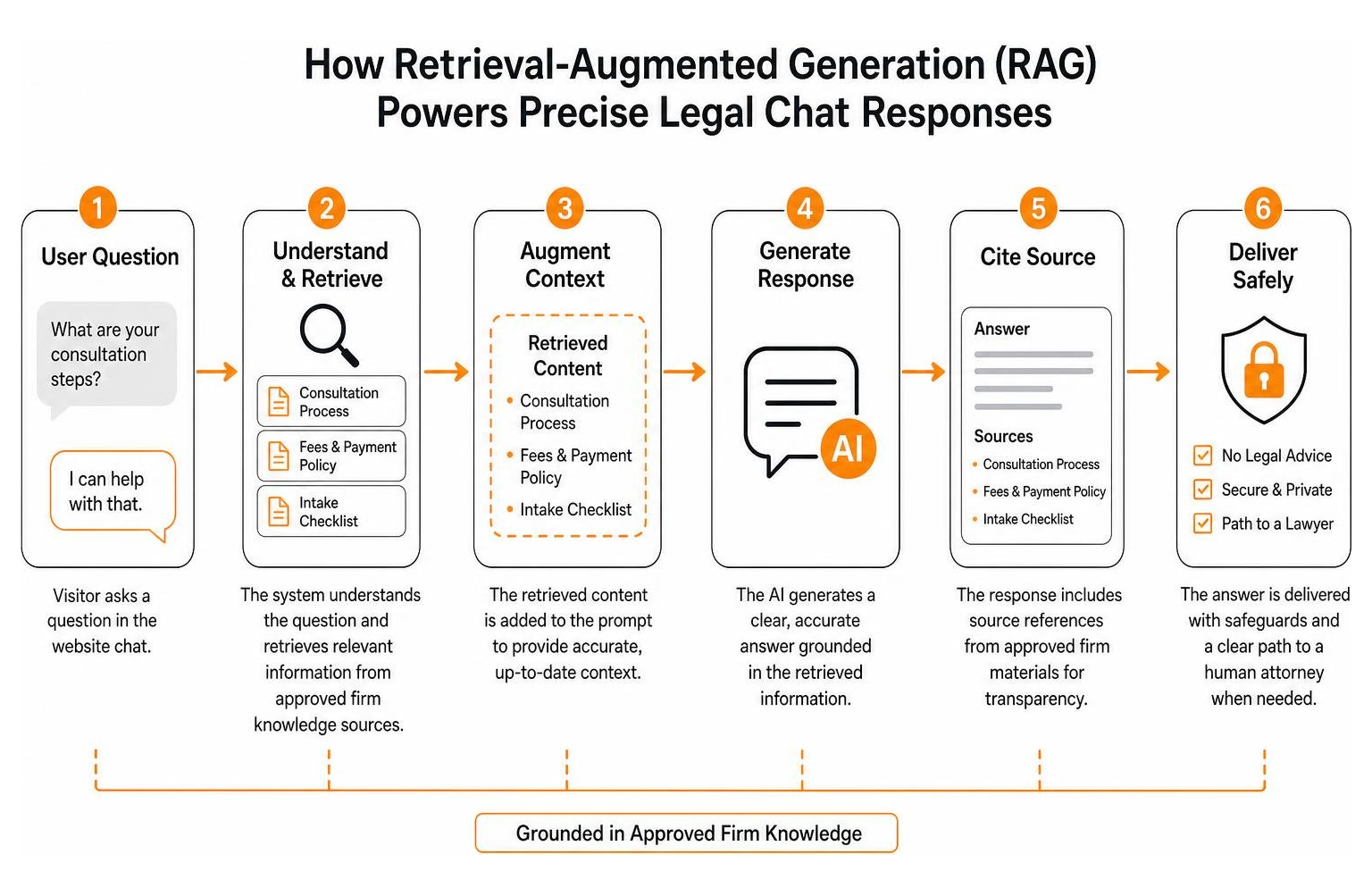
Core Capabilities of an AI Law Firm Chatbot
A dedicated legal chatbot handles essential front-office administrative interactions so your legal team can focus on billable casework. Key capabilities include:
- Automated Client Intake: Capturing prospect contact information, matter type, timeline, and jurisdiction through guided conversations.
- Initial Lead Screening: Asking customized screening questions to identify potential conflicts of interest and check baseline case viability.
- Consultation Scheduling: Connecting directly with attorney calendars to allow qualified prospects to book initial consultations in real time.
- Document Summarization & Collection: Providing clients with necessary document checklists and securely accepting intake filings.
- FAQ Automation: Providing instantaneous answers regarding office locations, retainer payment steps, parking, and consultation expectations.
- Multi-Channel Messaging: Connecting website widgets, SMS, WhatsApp, and social channels into a unified conversational inbox.
By deploying an AI Chatbot for Legal & Compliance or an AI Chatbot for Legal Services Teams, firms can automate up to 50% of routine client communications without inflating overhead costs.
Embedded vs Standalone Legal Chat Systems
When choosing a law firm chatbot, firm leaders face a critical structural decision: selecting an embedded tool versus a third-party standalone system.
Embedded chatbots live directly within your existing legal practice management platform or CRM system. Because they share the same central database, they preserve client record consistency and eliminate application-switching fatigue for staff. Modern embedded platforms often use dedicated API integrations hosted on enterprise infrastructure to enforce Zero Data Retention (ZDR) policies, deleting user input tokens immediately after generating a response to ensure data privacy.
Standalone third-party chat software, while often fast to deploy, runs outside your case management system. While standalone platforms can pass leads through webhooks, they can create data silos if not tightly configured. Evaluating how smoothly software passes structured intake briefs directly into your legal workflow is essential when selecting a platform.
The Business Benefits and ROI of AI Legal Chat Solutions

Industry studies consistently highlight a stark gap in modern legal communications: while nearly 80% of prospective clients expect a firm to respond within 24 hours of reaching out, the average law firm takes well over 24 hours to return web inquiries. Even more striking, research indicates that roughly 42% of all legal inquiries arrive outside standard business hours (between 5 PM and 9 AM).
When a prospective client facing a stressful legal issue reaches out after hours, they rarely wait for morning callbacks—they simply move on to the next firm on Google.
Implementing smart conversational software fundamentally changes your firm’s growth trajectory by converting static website traffic into qualified consultations 24 hours a day, 7 days a week.
Streamlining Client Intake and Pre-Qualification
Lawyers spend approximately 30% of their working day on non-billable administrative chores—such as answering basic inquiry phone calls, sending intake emails, and setting up initial consultation appointments. High intake friction also increases phone anxiety for prospective clients, many of whom hesitate to call a law office directly during work hours.
An automated AI Chatbot for Lawyers | Smart and Secure Legal Operations bridges this gap by offering a comfortable, low-pressure text interface. The chatbot asks pre-programmed qualification questions:
- "What type of legal matter do you need help with?"
- "In which state or county did this incident take place?"
- "Are there active court deadlines or hearing dates scheduled?"
- "What are the opposing parties' names?" (to flag potential conflict checks)
Once the visitor provides these details, solutions such as Automate Legal Client Enquiries with AI | Kyanite compile the raw dialogue into a structured intake brief. When your staff arrives in the morning, they review a clean executive summary rather than reading through lengthy email threads or unvetted voicemails.
Measuring Return on Investment and Efficiency Gains
Quantifying the return on investment (ROI) of a law firm chatbot involves examining both cost reductions and revenue growth.
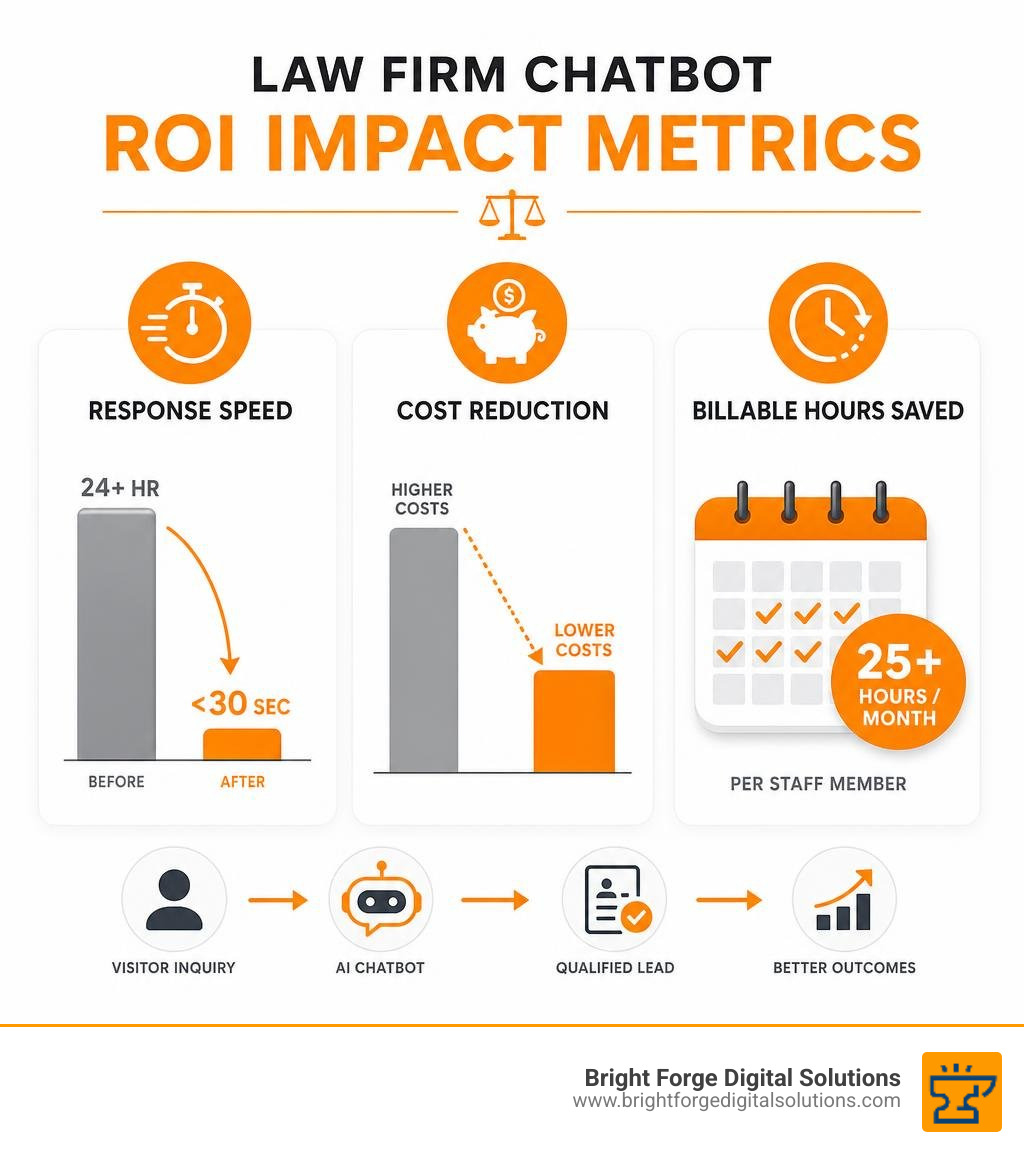
Key performance indicators (KPIs) to track include:
- Lead Response Velocity: Reducing initial lead response times from 24+ hours down to under 30 seconds.
- Conversion Rate Lift: Converting interactive web visitors at significantly higher rates compared to standard contact forms. You can explore how improved conversion funnels double or quadruple prospective lead flows with our guide on 4x Conversions.
- Billable Hour Recovery: Legal professionals saving an average of 25+ hours per month per staff member by automating routine intake and administrative inquiries.
- Operational Cost Reduction: Industry metrics demonstrate a 15% to 20% drop in overall intake processing costs within the first year of deployment.
- Lower Cost-Per-Acquisition (CPA): Maximizing the ROI of digital advertising campaigns, such as Google Advertising, by instantly engaging ad clicks before prospects return to search results.
Security, Compliance, and Ethical Considerations for Legal Chatbots

Law firms hold a sacred trust regarding client confidentiality and data security. Deploying website technology without verifying enterprise security standards exposes a firm to severe regulatory, ethical, and reputational risk.
When evaluating a legal chatbot vendor, verify compliance with standard data protection protocols:
| Security Standard | Target Requirement | Purpose in Legal Tech |
|---|---|---|
| Data Encryption | TLS 1.3 (Transit) / AES-256 (Rest) | Encrypts intake chatter against eavesdropping and database breaches. |
| SOC 2 Type II | Audited Compliance | Validates operational security, availability, and processing integrity. |
| HIPAA Readiness | Signed Business Associate Agreement (BAA) | Safeguards Protected Health Information (PHI) in personal injury or medical malpractice intake. |
| GDPR / CCPA | Consent & Right-to-Forget | Ensures transparent user consent and data erasure protocols. |
| Zero Data Retention | Mandatory Model Policy | Guarantees vendor LLMs do not retain or train model parameters on firm client text. |
Preventing Unauthorized Practice of Law and Safeguarding Privilege
The most critical legal boundary for any law firm chatbot is preventing the Unauthorized Practice of Law (UPL). Under bar ethics rules across all jurisdictions, automated software cannot issue legal advice, apply law to specific facts, or form an attorney-client relationship.
To maintain strict compliance:
- Clear Disclaimers: Every chat window must feature prominent disclaimers stating that the software is an administrative assistant, cannot provide legal advice, and that using the chat does not establish an attorney-client relationship.
- Scoping Limitations: Scope chatbot knowledge strictly to non-substantive case administration—such as office locations, payment options, consultation prerequisites, and basic procedure updates.
- Automated Escalation Triggers: When a user asks substantive legal questions (e.g., "What is my slip-and-fall case worth?" or "How do I draft an answer to this complaint?" ), the system must immediately state its boundaries and offer to route the question to a human attorney.
- Privilege Awareness: As platforms like Conversation Bot for Law Firms | Agaro emphasize, chats taking place prior to formal retention must be logged in isolated, encrypted databases to preserve prospective client confidentiality without creating discoverability issues.
Ethical Best Practices for Deploying a Law Firm Chatbot
Transparency is both an ethical best practice and a legal requirement in many jurisdictions. For example, California law explicitly mandates that automated chatbots disclose to users that they are communicating with an AI or automated system, not a human being.
Additionally, maintaining detailed timestamped chat logs and audit trails ensures full alignment with regulatory oversight bodies (such as SRA AML compliance checks in international legal jurisdictions), giving firms verifiable proof of compliance from the client's first interaction.
Best Practices for Implementing Legal Chat Software
Implementing a law firm chatbot should streamline your practice, not create administrative confusion. Following a structured rollout methodology ensures safety, client satisfaction, and rapid staff adoption.
1. Curate a Knowledge Base
Start by gathering approved practice area guides, fee policies, directions, and common intake questions. Grounding your chatbot in your firm's own documentation prevents inaccurate outputs or off-brand messaging.
2. Define the Brand Voice and Personality
Configure your tool to speak in a warm, empathetic, and professional voice. Potential legal clients are often experiencing stressful life events; your chat tone should convey trust, legal authority, and calm reassurance.
3. Conduct a 30-Day Pilot
Never launch a chatbot across your entire firm overnight. Run a 30-day trial restricted to a single high-volume practice area (such as family law or personal injury intake).
4. Implement Human-in-the-Loop Safeguards
Establish rules where human intake specialists review automated summaries before contacting prospects. Shadow initial chat transcripts during the pilot phase to refine response accuracy.
5. Perform Continuous Evaluation
Run periodic tests against historical client questions to verify that model updates keep software responses aligned with your firm's standards.
At Bright Forge Digital Solutions, we help solo and small practices integrate AI tools alongside high-impact search strategies like our performance-based Pay Per Result SEO model. Combining search engine visibility with immediate lead capture ensures your firm converts online traffic into loyal clients.
Frequently Asked Questions About Law Firm Chatbots
Can a legal chatbot give legal advice to website visitors?
No. A law firm chatbot cannot provide legal advice, interpret statutes for specific factual scenarios, or evaluate case merits. Only a licensed attorney can deliver legal counsel. Legal chatbots are engineered strictly to provide general administrative information, answer routine operational FAQs (such as office hours and consultation policies), collect initial intake information, and schedule attorney consultations. Modern legal chatbots enforce strict guardrails and automated disclaimers that clarify their non-lawyer status to website visitors.
How do law firm chatbots handle client confidentiality and data privacy?
Reputable legal chat systems protect client data using enterprise security measures, including end-to-end encryption (TLS 1.3 for data in transit and AES-256 for data at rest), SOC 2 Type II compliance, and strict adherence to data privacy regulations like GDPR and CCPA. Furthermore, leading legal AI providers enforce Zero Data Retention (ZDR) policies, meaning incoming user text is never stored permanently on third-party servers or used to train public language models, keeping prospective client disclosures confidential.
What tasks still require human lawyer intervention?
While chatbots streamline administrative inquiries, key substantive tasks always require human legal judgment:
- Providing strategic legal counsel tailored to client goals
- Analyzing complex legal precedents and statutory interpretations
- Drafting formal court pleadings and settlement agreements
- Conducting courtroom advocacy and depositions
- Exercising professional judgment during sensitive client negotiations
Conclusion
In 2026, website visitors expect instantaneous answers. When someone faces a pressing legal dispute or injury, waiting 24 to 48 hours for an email callback is no longer acceptable. Deploying a specialized law firm chatbot transforms your website from a passive brochure into an active 24/7 lead capture tool.
By automating administrative inquiries, capturing complete client intake details, and reducing non-billable overhead, your legal team can focus on what matters most: serving your clients and delivering exceptional legal outcomes.
If you are ready to expand your online visibility, capture high-intent leads, and modernize your intake workflow, explore our comprehensive digital marketing services at Bright Forge Digital Solutions today.