Market Drivers: Why Demand for Estate Planning Leads is Surging

The market dynamics surrounding estate planning attorney leads are shifting dramatically. Driven by demographic changes and complex legal frameworks, demand for estate planning services has reached an all-time high.
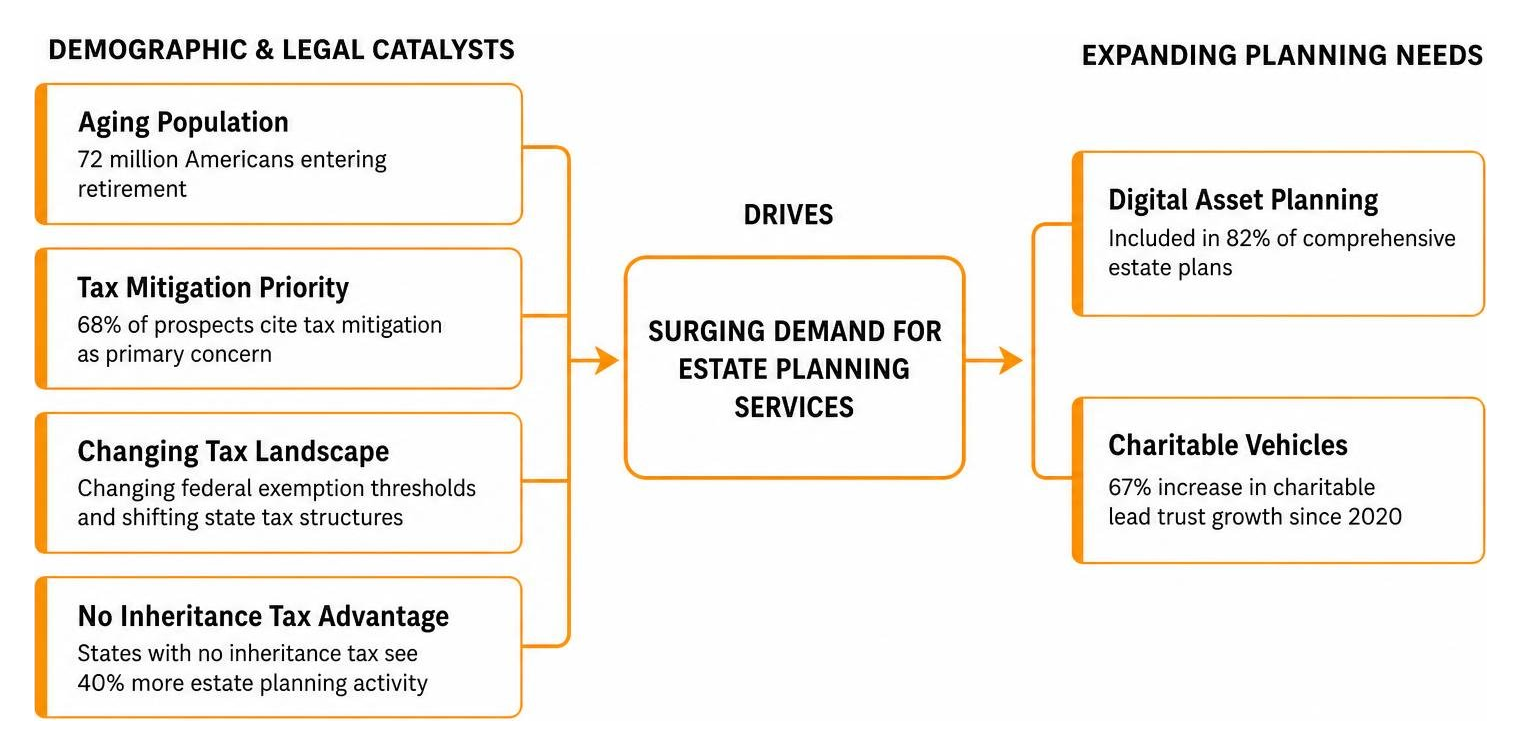
An aging population of 72 million Americans is entering retirement, causing an urgent push toward securing financial legacies. Prospective clients are no longer just looking for simple wills; they require comprehensive asset protection.
Tax considerations are the primary catalyst driving consumer behavior. Statistics show that 68% of prospects contacting estate planning attorneys specifically mention tax mitigation as their primary concern. Changing federal exemption thresholds and shifting state tax structures have forced individuals to audit their financial posture. Attorneys and consumers commonly monitor IRS guidance on estate and gift taxes when evaluating federal planning considerations. In fact, states with no inheritance tax are experiencing 40% more estate planning activity as residents relocate or restructure assets to capture tax efficiencies.
Modern estate planning has also evolved far beyond physical property and liquid accounts:
- Digital Asset Planning: Digital asset management is now included in 82% of comprehensive estate plans, covering everything from online business equity and cryptocurrency holdings to cloud data and domain portfolios.
- Charitable Vehicles: High-net-worth clients are increasingly incorporating philanthropy into their structures, driving a 67% increase in charitable lead trust growth since 2020.
| Metric / Consideration | Estate Planning | General Legal Practice Areas |
|---|---|---|
| Average Case Value | $18,500 | $3,500 - $5,000 |
| Primary Consumer Driver | Wealth transfer & tax mitigation (68%) | Immediate dispute or crisis resolution |
| Client Lifetime Value | High (recurring updates, trust administration, probate) | Low (one-off transactional representation) |
| Lead Urgency Profile | High intent, highly consultative decision-making | High urgency, immediate reactive booking |
Case Value Metrics and Estate Planning ROI
Acquiring qualified estate planning attorney leads delivers a substantial return on investment compared to other consumer-facing practice areas. While standard flat-fee documents provide steady cash flow, high-net-worth estate planning yields impressive long-term revenues.
The baseline average case value for estate planning leads stands at $18,500. When handling complex family structures, multi-state real estate portfolios, or closely held business successions, average case values range from $25,000 to $150,000 depending on asset complexity and jurisdictional requirements. Estate planning leads yield roughly four times the average case value of general legal matters.
Investing in long-term organic lead flow protects your firm's revenue trajectory. Practices that optimize their web visibility generate sustainable inbound clients without relying indefinitely on expensive pay-per-click budgets. Understanding your campaign economics by calculating your Law Firm SEO ROI allows you to reinvest predictable profits into growing your firm.
Evaluating Paid Services for Estate Planning Attorney Leads
Purchasing pay-per-lead inventory can supplement your organic growth. However, not all lead vendors operate with equal integrity or delivery capabilities.
When evaluating paid platforms, you will encounter two primary delivery frameworks: shared leads and exclusive leads.
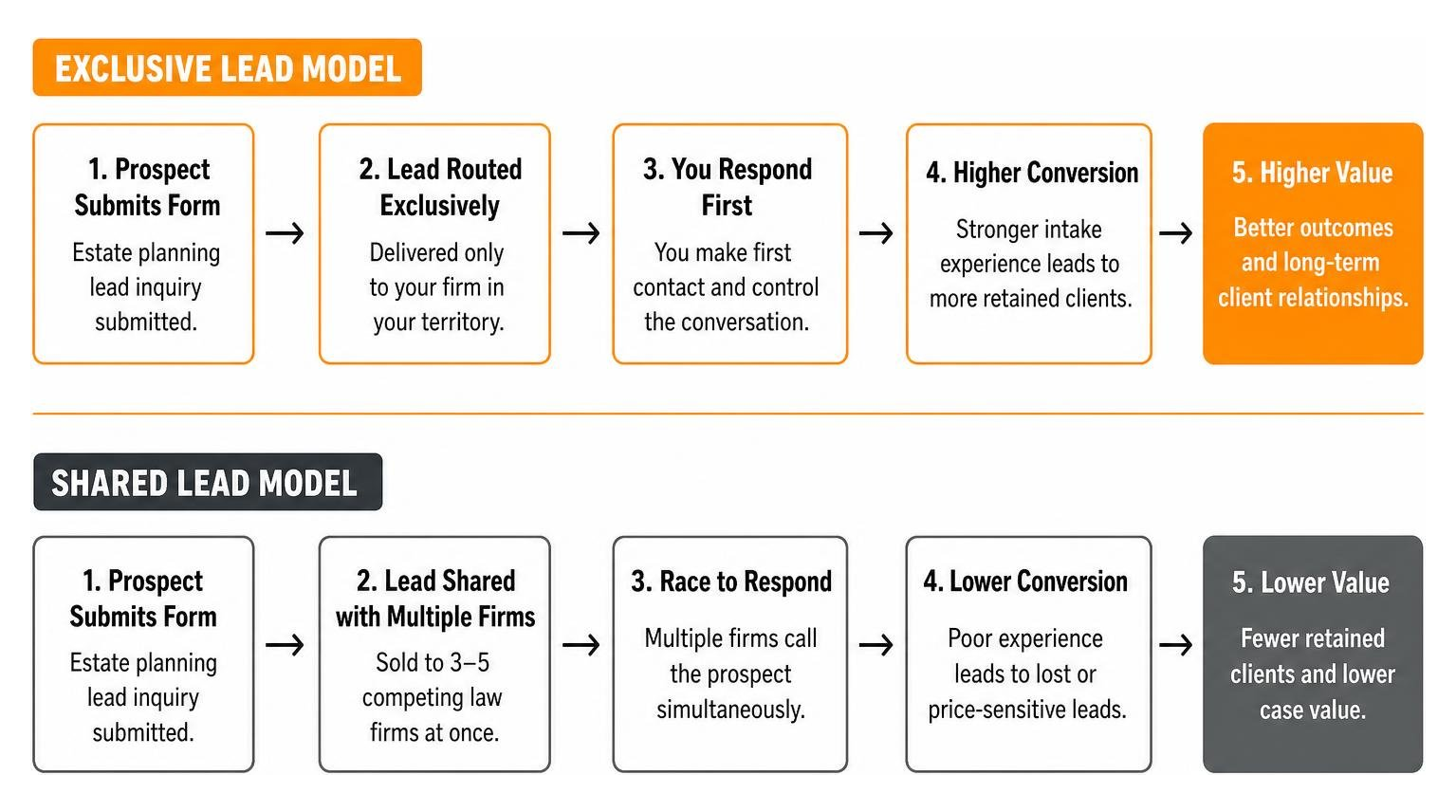
- Shared Leads: Sold to three to five competing law firms simultaneously. This triggers a race to the phone, degrades the prospect's intake experience, and forces firms into price wars.
- Exclusive Leads: Routed solely to your practice based on strict geographic territory protection. Exclusive leads command a higher price tag but convert at significantly higher rates because you control the initial consultation.
Prioritize lead vendors that feature real-time alert systems via webhooks or direct API integrations into your Law Firm CRM. Receiving lead data the second a prospect fills out an online form is vital for conversion.
Ethics and state bar compliance are critical when purchasing leads. Ensure your lead provider complies with state non-duplication guidelines and bar association regulations regarding fee-splitting. Standard rules prohibit pay-per-lead services from taking a percentage of your legal fees. Instead, providers must charge a flat, transparent cost-per-lead (CPL) fee regardless of whether the lead ultimately retains your services. Third-party lead services offer location-based options tailored to regional legal markets.
Cost Per Lead Benchmarks for Estate Planning Attorney Leads
Navigating vendor pricing structures requires knowing current CPL benchmarks across the legal industry.
- Shared Pay-Per-Lead Services: Basic directory listings and shared digital leads generally range from $20 to $40 per lead.
- Unbundled / Specific Scope Vendors: Services offering specialized or unbundled legal leads range between $50 and $100 per lead.
- Exclusive Live Transfer Leads: Exclusive, phone-verified live call transfers pre-screened for income or asset thresholds command $100 to $250+ per lead.
- Subscription Directory Models: Platforms charging flat annual fees for directory placement cost anywhere from $4,000 to over $30,000 annually in major metropolitan legal markets.
While shared leads look attractive on paper due to lower upfront costs, exclusive leads generally yield a superior ROI because they eliminate price competition and generate higher conversion rates.
Best Practices for Qualifying Estate Planning Attorney Leads
Lead volume means nothing if your intake staff wastes hours speaking with unverified prospects who lack assets or intent. Implementing rigorous qualification protocols ensures your attorneys spend time only on high-value consultations.
- Set Baseline Asset Thresholds: Configure online intake forms and screening call scripts to filter for minimum asset metrics (e.g., households holding over $500,000 in investable assets or real estate).
- Evaluate Family & Structural Complexity: Ask preliminary questions about blended families, business entity ownership, and international holdings during automated intake.
- Verify Timing & Intent: Distinguish between casual researchers and prospective clients who plan to finalize their estate plan within the next 30 to 60 days.
- Automated CRM Routing: Utilize smart intake software to instantly tag, segment, and route high-asset leads directly to senior attorneys, while routing basic inquiries to automated scheduling workflows.
Organic Lead Generation Strategies Beyond Paid Services
Relying exclusively on paid lead channels leaves your firm vulnerable to rising ad costs and unpredictable vendor inventory. Building an organic lead engine creates sustainable, long-term prospective client acquisition.
Educational content marketing establishes your authority before a prospect ever reaches out. Developing clear guides on complex topics—such as revoking revocable living trusts, structuring special needs trusts, or navigating probate court—captures high-intent searches from consumers actively looking for legal help.
Hosting targeted virtual webinars and local community workshops creates direct connections with potential clients. Topics such as "Protecting Your Wealth from State Taxes" or "Navigating the $68 Trillion Wealth Transfer" allow prospective clients to evaluate your legal expertise in a relaxed, educational setting.
Auditing Your Law Firm Digital Presence
Your online presence is often the very first interaction a potential client has with your law practice. A single broken form or inconsistent phone number can cost you thousands in lost revenue.
To audit your digital footprint for optimal client capture:
- Verify NAP (Name, Address, Phone) Consistency: Ensure your business name, physical office address, and primary phone number match across all online directories, legal portals, and social media platforms.
- Optimize Your Google Business Profile: Claim and complete every field on your profile. Categorize your firm under primary legal categories like "Estate Planning Attorney" and "Elder Law Attorney," upload photos of your physical office space, and publish regular Google Posts highlighting educational legal content.
- Test Contact Forms and Live Chat: Test your website forms, interactive intake bots, and click-to-call links across mobile and desktop devices every month to guarantee flawless functionality.
- Track Inbound Attribution: Use dynamic call tracking and unique phone numbers to track exactly which digital channels generate your best phone leads.
To refine your firm's online visibility, review our comprehensive guide on Local SEO for Law Firms.
Cultivating Financial Advisor and CPA Referral Networks
High-net-worth clients frequently turn to their trusted financial advisors and Certified Public Accountants (CPAs) before seeking out an estate planning lawyer. Building strategic referral partnerships provides a reliable stream of qualified clients.
To build a professional referral system:
- Schedule Regular Check-ins: Meet quarterly with local accounting firms, wealth management teams, and non-competing legal professionals (such as personal injury or real estate attorneys) to discuss industry changes and client cross-referrals.
- Host Co-Branded Educational Events: Partner with a financial advisor to co-host a joint virtual seminar. The financial advisor speaks on asset management, while you address legal estate frameworks, giving both practices access to each other's audiences.
- Deliver Reciprocal Value: Refer your estate planning clients to your accounting and financial planning partners when their tax or investment strategies need updating.
Speed and Intake Protocols to Maximize Lead Conversion Rates
Acquiring high-intent estate planning attorney leads is only half the equation; your firm must also be equipped to convert them. Intake speed is the single most important variable in conversion success.
Research shows that responding to an inbound legal lead within 15 minutes increases your overall conversion rate by 43%. Waiting hours or days to return a phone call or digital contact form drops conversion rates significantly, as prospective clients quickly move down the search page to contact a competitor.

Establish round-the-clock intake capabilities by pairing dedicated intake specialists with automated SMS notifications. The moment a client submits a form, an automated text message should go out confirming receipt and offering an immediate calendar booking link.
Educate prospective clients on scope and baseline fees prior to or during the initial consultation call. Explaining flat-fee tiers or unbundled legal packages upfront removes pricing ambiguity, reduces intake friction, and builds immediate trust.
Building Client Communication and Review Loops
Client acquisition does not end when a client signs a representation agreement. Former clients are your absolute best source for future estate plan reviews, trust administration work, and word-of-mouth referrals.
Maintain long-term client loyalty by establishing structured review and communication loops:
- Automated Review Requests: Send automated text and email review requests right after delivering a completed estate plan. Earning consistent 5-star Google reviews boosts your local map pack rankings and builds instant social proof for new prospective leads. Learn more about effective review gathering in our guide on Google Lawyer Reviews.
- Life Milestone Triggers: Touch base with clients every two to three years—or after major life events like marriages, births, divorces, or home purchases—to offer estate plan updates.
- Quarterly Educational Newsletters: Send useful quarterly email updates covering shifting tax laws, digital asset updates, and basic wealth management tips to stay top of mind.
Frequently Asked Questions About Estate Planning Attorney Leads
How much do estate planning attorney leads typically cost?
The cost of estate planning leads varies based on geographic market, lead exclusivity, and qualification level. Shared internet directory leads generally run between $20 and $40 per lead. Exclusive, pre-screened leads or real-time phone transfers range from $50 to $100+ per lead. Specialized high-net-worth leads verified for substantial asset thresholds can cost upwards of $150 to $250 each.
How quickly should a law firm respond to prospective estate planning leads?
Firms should aim to respond to inbound inquiries within 15 minutes or less. Research demonstrates that responding within this initial 15-minute window yields a 43% boost in prospective client conversion rates. Setting up instant SMS auto-responders and routing leads immediately to dedicated intake staff ensures you connect with prospects before they reach out to competing practices.
How do estate planning leads compare in value to leads in other practice areas?
Estate planning leads generally offer exceptional lifetime client value. The baseline average case value for estate planning leads stands at $18,500, with complex high-net-worth matters ranging from $25,000 to $150,000. This represents roughly four times the average value of general legal matters. Furthermore, estate planning clients often return for periodic plan updates and generate high-value probate, trust administration, and family referral cases down the road.
Sustainable Practice Growth Through Organic Leads
Building a profitable law firm requires a balanced approach to acquiring estate planning attorney leads. While buying exclusive paid leads can quickly fill immediate intake pipelines, long-term practice growth rests on building an organic digital presence you own outright.
At Bright Forge Digital Solutions, we help solo practitioners and small law firms build dominant local digital presences using performance-focused strategies. Through our pay-per-result search engine optimization models, firm-focused review engines, and custom Local SEO strategies, we partner with attorneys to capture high-intent local clients without the ongoing burden of expensive pay-per-click costs.

Ready to stop chasing unpredictable leads and start building an automated inbound growth engine for your law firm? Discover how our performance-driven agency can help transform your online visibility.